
The Science and Application of Polyaspartic Concrete Protection
Securing a durable concrete surface requires understanding the harsh local environment. An authoritative Garage Floor Coating Service in Houston, Texas, provides the necessary barrier between raw, porous concrete and the destructive forces of humidity, chemical spills, and heavy vehicular traffic. Our coatings are designed for minimal maintenance and long-term durability, giving homeowners peace of mind about their investment.
Analyzing Concrete Vulnerability in Houston
Concrete is inherently porous and susceptible to environmental degradation, especially within the Gulf Coast climate. High ambient temperatures, intense ultraviolet radiation, and fluctuating ground moisture act in concert to erode untreated concrete slabs.
The Impact of Regional Climate Conditions
The geographical environment in Houston introduces constant challenges to concrete integrity. Heavy rainfall and severe humidity create a cycle of expansion and contraction within the concrete capillary network. When moisture penetrates the surface, it carries dissolved minerals that crystallize and expand, slowly breaking down the structural matrix from the inside out. Research on how humidity and Heat Affect Concrete Floor Coatings shows that applying standard, rigid resins to such a dynamic substrate inevitably leads to structural failure. To effectively protect these spaces, a coating must possess the elasticity to move in tandem with the concrete slab as temperatures fluctuate throughout the day.
Addressing Soil Composition and Shifting Slabs
The regional soil, primarily expansive gumbo clay, undergoes dramatic volume changes with seasonal rainfall. This constant shifting applies immense mechanical stress to residential and commercial foundations. As the slab moves, it develops micro-fractures and surface spalls. An effective Floor Coating Service in Houston, Texas, must account for this movement. Rather than merely painting the surface, the application must use deep-penetrating resins that bind the aggregate and provide a flexible, cohesive layer that absorbs mechanical shock without fracturing.
The Inherent Flaws of Standard Epoxy Coatings
Standard epoxy has been used for decades, but advances in materials science have exposed its significant structural and chemical limitations. FloorTek explicitlies avoid epoxy because it is an outdated, rigid material that typically fails under real-world conditions.
The Rigidity and Brittleness of Epoxy Resins
Epoxy consists of large, tightly crosslinked molecules that cure into an extremely hard but brittle surface. This rigidity is its primary downfall. When a concrete slab expands under the Texas sun or shifts due to soil movement, the epoxy cannot stretch. The resulting tension causes the epoxy to snap, leading to visible cracks, flaking, and total delamination from the substrate.
The Destruction Caused by Hot Tire Pickup
One of the most common reasons standard epoxy fails is a phenomenon known as hot tire pickup. As vehicles are driven, the tires generate significant heat through friction. When a heavy, hot vehicle is parked on an epoxy-coated surface, the elevated temperature softens the epoxy resin. The rubber tread of the tire bonds mechanically to the softened epoxy. As the tire cools and contracts, it rips the brittle epoxy layer off the concrete entirely. This creates deep, unsightly divots in the flooring. Polyaspartic coatings possess a much higher thermal tolerance, neutralizing this threat entirely.
Ultraviolet Degradation and Yellowing
Standard epoxy is formulated with aromatic isocyanates. In chemical terms, aromatic compounds contain ring structures that absorb ultraviolet radiation. When exposed to sunlight, these chemical rings break down rapidly, causing the clear epoxy finish to turn amber, chalky, and opaque. This degradation weakens the molecular bonds, leading to a powdery surface that easily scuffs and scratches. Because of this fatal flaw, standard epoxy is largely useless in environments exposed to natural light, whereas aliphatic compounds, which do not contain these light-absorbing rings, remain clear.
Engineering Superiority: Polyaspartic Technology
To overcome the limitations of outdated resins, the industry has shifted toward polyaspartic ester polyurea.
Understanding Aliphatic Polyurea Chemistry
Polyaspartic technology uses an aliphatic molecular structure, meaning its chemical bonds are highly stable and do not degrade under environmental conditions. The result is a coating that is inherently UV Stable and maintains high optical clarity for decades. According to data from the National Center for Biotechnology Information, polyaspartic polyurea exhibits exceptional mechanical properties, boasting high elongation and tensile strength exceeding 43 MPa. This allows the material to flex, stretch, and absorb heavy impacts without sustaining damage.
The Chemical Foundation of Strength
The unique curing process of polyaspartic compounds allows the material to penetrate deeply into the open pores of the mechanically prepared concrete.
Proper surface preparation and moisture management are essential for lasting results. Addressing slab moisture content ensures property managers feel confident in the durability and effectiveness of FloorTek's professional installation, preventing future issues.
The Physics of Moisture Vapor Transmission
Concrete acts like a hard sponge. Even if the surface appears completely dry, moisture from the soil beneath the foundation is constantly rising through the concrete's microscopic capillary tubes in a process known as Moisture Vapor Transmission (MVT).
The Methodical Application and Preparation Process
The long-term success of any flooring upgrade depends almost entirely on the quality of the surface preparation. A proper Floor Coating Service requires that the concrete be mechanically profiled.
Mechanical Surface Profiling
We never use acid etching because it produces an insufficient profile and introduces unnecessary moisture into the slab. Instead, we utilize heavy-duty, planetary diamond grinders equipped with industrial vacuums. The diamond grinding process removes the smooth, contaminated top layer of the concrete, eradicating old stains, sealers, and weak laitance. This grinding action achieves a specific Concrete Surface Profile (CSP), exposing the open pores of the aggregate. This aggressive texture is absolutely mandatory for the polyaspartic base coat to penetrate and establish a permanent mechanical bond.
Structural Repair and Mending
Before any coating is applied, the profiled concrete must be structurally restored. Users often ask, Can You Coat a Severely Cracked Concrete Driveway? The answer relies on professional mending. We aggressively chase out existing cracks using specialized diamond blades, opening them up to receive our proprietary polyurea mending compounds. Pitting, divots, and spalls are completely leveled, ensuring the substrate is completely flat and structurally unified.
Base Coat Application and Flake Broadcasting
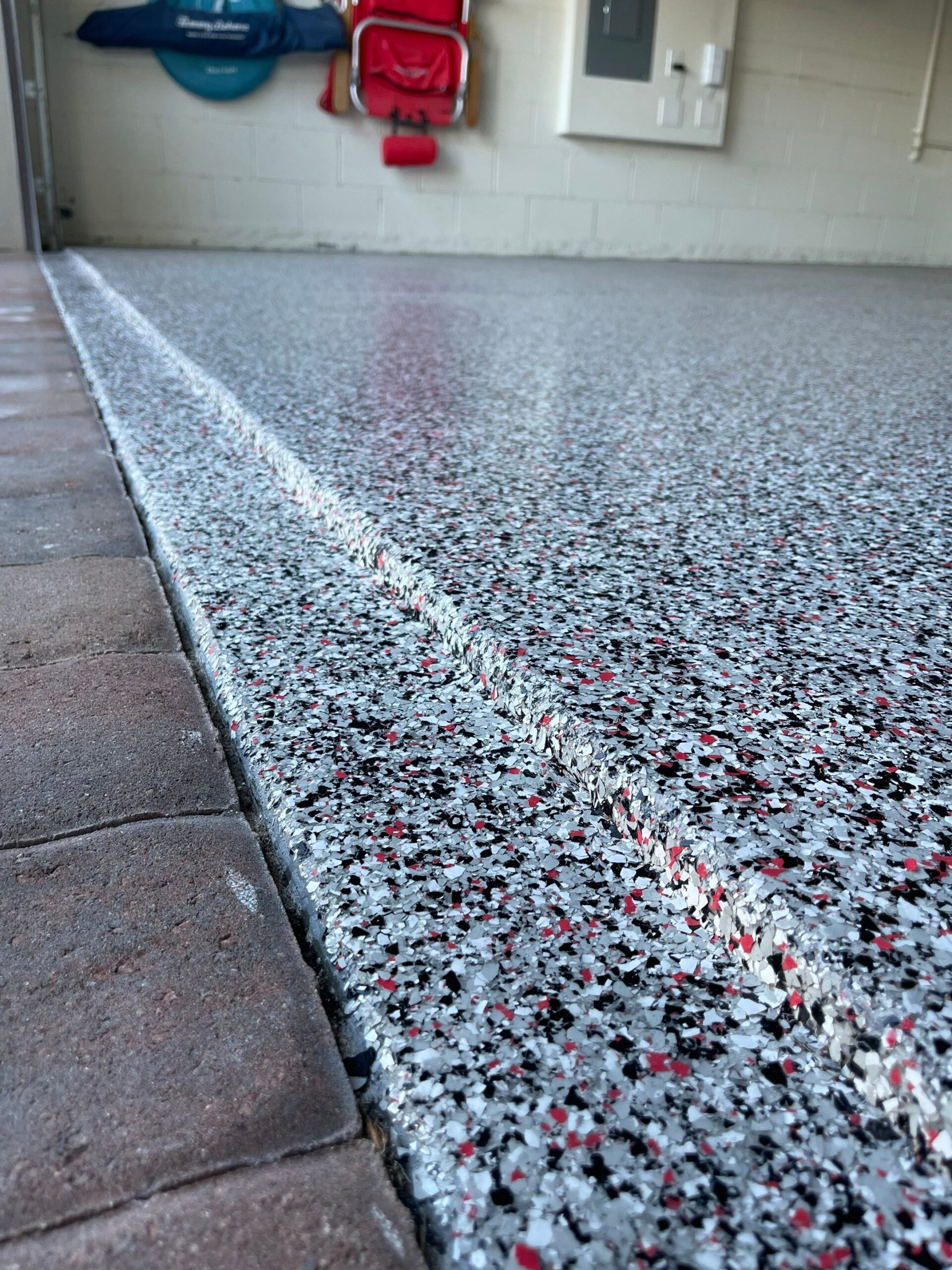
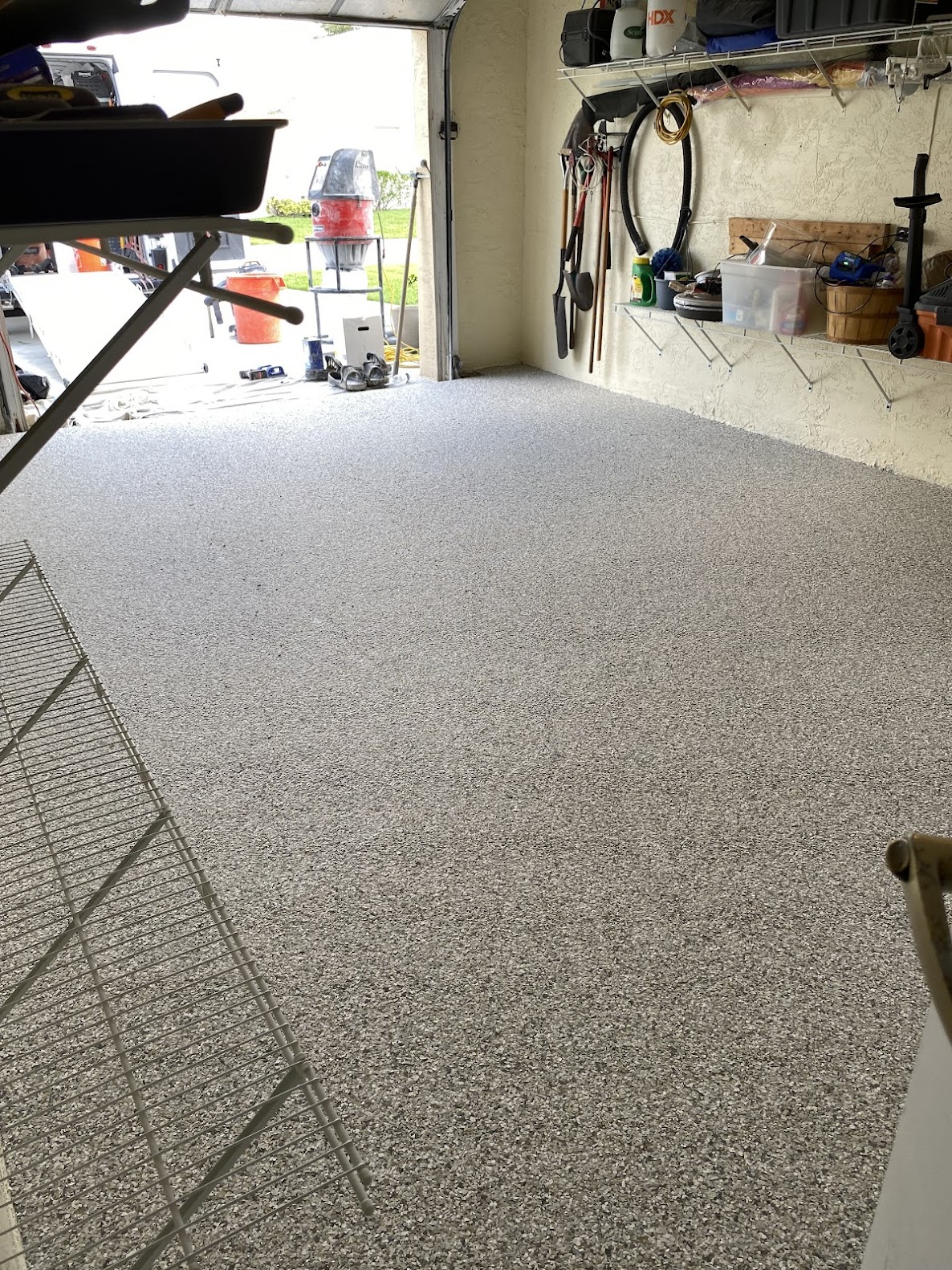
Once the surface is ground and repaired, the polyaspartic base coat is applied using specialized squeegees and rollers to ensure a uniform thickness. Immediately after the base coat is applied, decorative vinyl flakes are broadcast across the entire surface. This means the floor is completely covered with flakes until no wet resin is visible. The flakes serve dual purposes: they provide a visually stunning, granite-like texture and add physical thickness to the coating system, significantly enhancing its impact resistance.
Scraping and Topcoat Sealing
The entire floor is then aggressively scraped in multiple directions using heavy steel blades. This knocks down any vertical, jagged flakes, creating a uniform, level texture. Finally, the UV-stable polyaspartic clear topcoat is rolled over the surface.
Transforming Exterior Concrete Surfaces
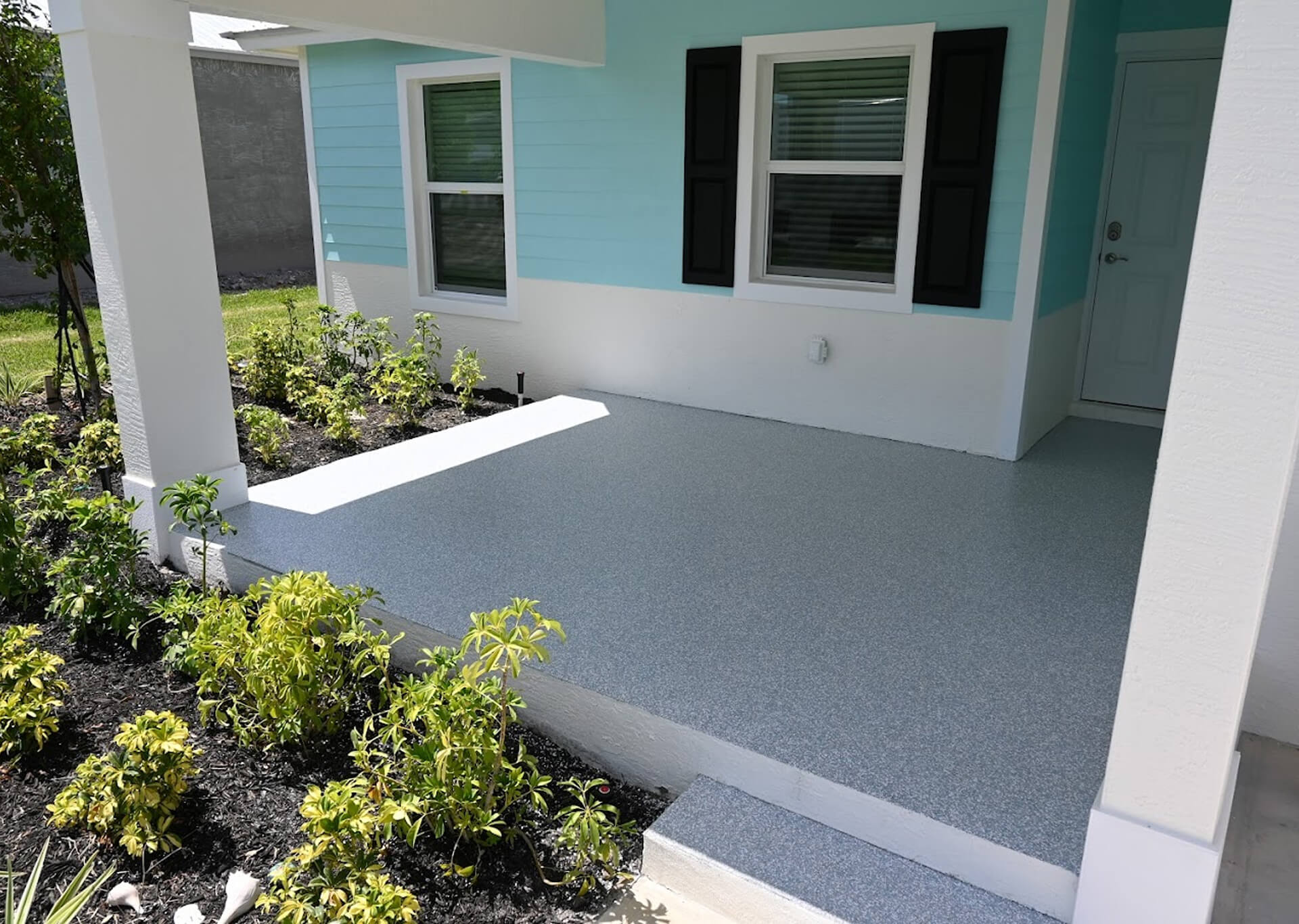
The robust nature of polyaspartic technology is not limited to interior spaces. Because the material is chemically formulated to resist ultraviolet radiation without breaking down, it is the ideal solution for protecting exterior concrete.
Enhancing Driveways and Sidewalks
Concrete driveways bear the brunt of heavy vehicular loads, oil leaks, and harsh sunlight. By deploying a specialized Driveways Floor Coating Service in Houston, Texas, property owners can protect their most utilized surfaces from degradation. The process prevents oil from staining the concrete and stops surface spalling caused by heavy rain. Similarly, a Sidewalk Floor Coating Service in Houston, Texas protects pedestrian pathways from accumulating deep-seated dirt and organic growth, keeping the property's exterior pristine.
Protecting Recreational and Rear-Facing Infrastructure
Rear patios and pool decks are constantly exposed to chlorinated water, direct sunlight, and foot traffic. For properties with specific recreational areas, a Pool Deck Floor Coating Service in Houston, Texas, ensures the substrate is protected from harsh pool chemicals that would rapidly dissolve standard paint or epoxy.
Customization and Protective Topcoats
The aesthetic versatility of a polyaspartic system allows it to complement any architectural style or branding requirement. The materials can be customized extensively without sacrificing any protective qualities.
Selecting the Right Aesthetics
Our diverse Colors and Flake Options allow clients to match their flooring to exterior paint schemes or interior decor. Whether you require a subtle, neutral grey tone or a vibrant, multi-colored aggregate blend, the vinyl flakes provide a consistent, premium finish. Viewing the FloorTek Gallery demonstrates the massive difference a professional flake system makes compared to bare concrete.
A major operational benefit of polyaspartic technology is the sheer speed at which it cures and cross-links.
The 1-Day Installation Advantage
We proudly offer a 1-Day installation protocol because our polyaspartic chemistry enables rapid layer buildup.
Warranty and Long-Term Value
We stand entirely behind the chemical engineering and precise application of our coating systems. We provide substantial Manufacturer-direct value by cutting out the middleman and passing the savings directly to the consumer.
Ensuring Peace of Mind
Understanding Floor Coating Warranties is crucial before committing to a surface upgrade.
Simplified Upkeep
Reviewing the Polyaspartic concrete coatings Care and Maintenance Guide highlights how easy it is to manage these upgraded surfaces. Routine maintenance typically involves nothing more than a soft-bristle broom and occasional mopping with a pH-neutral cleaner.
Booking Your Coating Assessment
Operating across multiple FloorTek Locations, we possess the logistical capability to serve the greater metropolitan area with speed and efficiency. You can learn more about us and our commitment to technical excellence by reviewing our operational history.
When you are ready to transform your space, contact us to schedule a comprehensive moisture and substrate assessment. Take advantage of our current promotion offering 30% off on the first installation to maximize your value. Call our primary line at 844-844-4164, or reach our local desk at (844) 844-4164. Visit our operational facility located at 4109 Katy Hockley Rd #1, Katy, TX 77493, to speak with our engineering staff in person.
Frequently Asked Questions:
Does high humidity impact a Garage Floor Coating Service in Houston, Texas?
YES. During a Garage Floor Coating Service in Houston, Texas, standard epoxy struggles to crosslink properly, often trapping moisture and leading to delamination or a cloudy finish upon drying.
We bypass this limitation entirely by utilizing polyaspartic chemistry, which uses ambient moisture to cure efficiently rather than fighting it. This provides a clear, highly resilient finish. Reach out to FloorTek Coating to secure a durable floor.
Is polyaspartic technology suitable for outdoor spaces during a Garage Floor Coating Service in Houston, Texas?
YES. Polyaspartic coatings are fundamentally designed to withstand direct ultraviolet radiation without breaking down or discoloring. Implementing this technology during a Garage Floor Coating Service in Houston, Texas,s ensures that driveways and outdoor concrete surfaces remain structurally sound and visually clear over time.
Standard epoxy rapidly degrades when exposed to the sun, rendering it completely unsuitable for outdoor environments. The aliphatic nature of polyaspartic means the molecular bonds do not absorb UV light aggressively. A study by the National Center for Biotechnology Information highlights its exceptional weather resistance. Contact FloorTek Coating for exterior applications.
What are the common problems with concrete floor coatings, and how can you avoid them during a Garage Floor Coating Service in Houston, Texas?
The primary failures involve delamination due to poor surface preparation, moisture vapor transmission, and hot tire pickup. You avoid these during a Garage Floor Coating Service in Houston, Texas, by enforcing strict diamond-grinding protocols and using advanced polyaspartic resins instead of brittle, older epoxy formulations.
Epoxy lacks the flexibility to handle substrate shifts and temperature fluctuations, whereas polyaspartic stretches and moves with the concrete base. The U.S.
Do temperature fluctuations cause hot tire pickup after a Garage Floor Coating Service in Houston, Texas?
YES. A standard Garage Floor Coating Service in Houston, Texas, that uses epoxy is highly susceptible to this specific failure due to the epoxy's low glass transition temperature.
By switching to a polyaspartic system, the coating maintains high thermal tolerance, effectively eliminating the risk of hot tire pickup. Research curated by the National Institutes of Health notes the extreme protective properties of polyurea variants against thermal and mechanical stress. Let FloorTek Coating protect your floor.
Can a Garage Floor Coating Service in Houston, Texas, repair existing concrete damage?
YES. Extensive surface preparation and mending are mandatory prerequisites before any resin application. A proper Garage Floor Coating Service in Houston,n Texas includes filling cracks, divots, and spalls with specialized polyurea binders to restore the structural continuity of the slab.
Standard epoxy bridges gaps, often cracking shortly after curing, whereas our polyaspartic mending compounds fuse directly with the concrete pores to provide a permanent structural repair. The U.S. Department of Transportation validates polyaspartic materials for their effectiveness in retaining loose concrete pieces. Rely on FloorTek Coating to reconstruct your surface.
Do salt or automotive fluids damage the results of a Garage Floor Coating Service in Houston, Texas?
NO. High-performance coatings are specifically engineered to block the penetration of automotive fluids, oils, and road salts. Completing a Garage Floor Coating Service in Houston, Texas,s with advanced polyaspartic resins creates a non-porous layer that completely shields the underlying concrete from chemical erosion.
Unlike epoxy, which can stain or soften when exposed to harsh chemicals, polyaspartic surfaces repel these substances, allowing for simple wipe-down maintenance. Trust FloorTek Coating for maximum defense.
Is mechanical surface profiling required during a Garage Floor Coating Service in Houston, Texas?
YES. Acid etching alone is insufficient for long-term adhesion, necessitating mechanical profiling. Any rigorous Garage Floor Coating Service in Houston, Texas, relies on heavy diamond-grinding machinery to remove the smooth top layer of concrete and expose open pores so the base coat can penetrate.
Epoxy applied to unprofiled concrete will inevitably peel under stress. Polyaspartic coatings require a properly textured substrate to achieve a permanent, deep-rooted mechanical bond. The National Center for Biotechnology Information emphasizes that good adhesion is critical to withstand sediment abrasion and structural deformation. Contact FloorTek Coating for professional preparation.
Will UV radiation cause discoloration after a Garage Floor Coating Service in Houston, Texas?
NO. Advanced coatings utilize an aliphatic molecular structure that inherently resists ultraviolet degradation and yellowing. Opting for a Garage Floor Coating Service in Houston, Texas that features a polyaspartic topcoat ensures your floor maintains its original clarity and color depth indefinitely.
Conversely, standard epoxy is aromatic by nature, meaning it reacts aggressively to sunlight and turns amber or chalky within a few months of exposure. The National Institutes of Health explicitly supports polyaspartic ester polyurea systems for their functional stability in challenging environments. Choose FloorTek Coating to preserve aesthetic value.
FREE In-Home Estimate
Plus 30% Off
Update Your Garage Today!
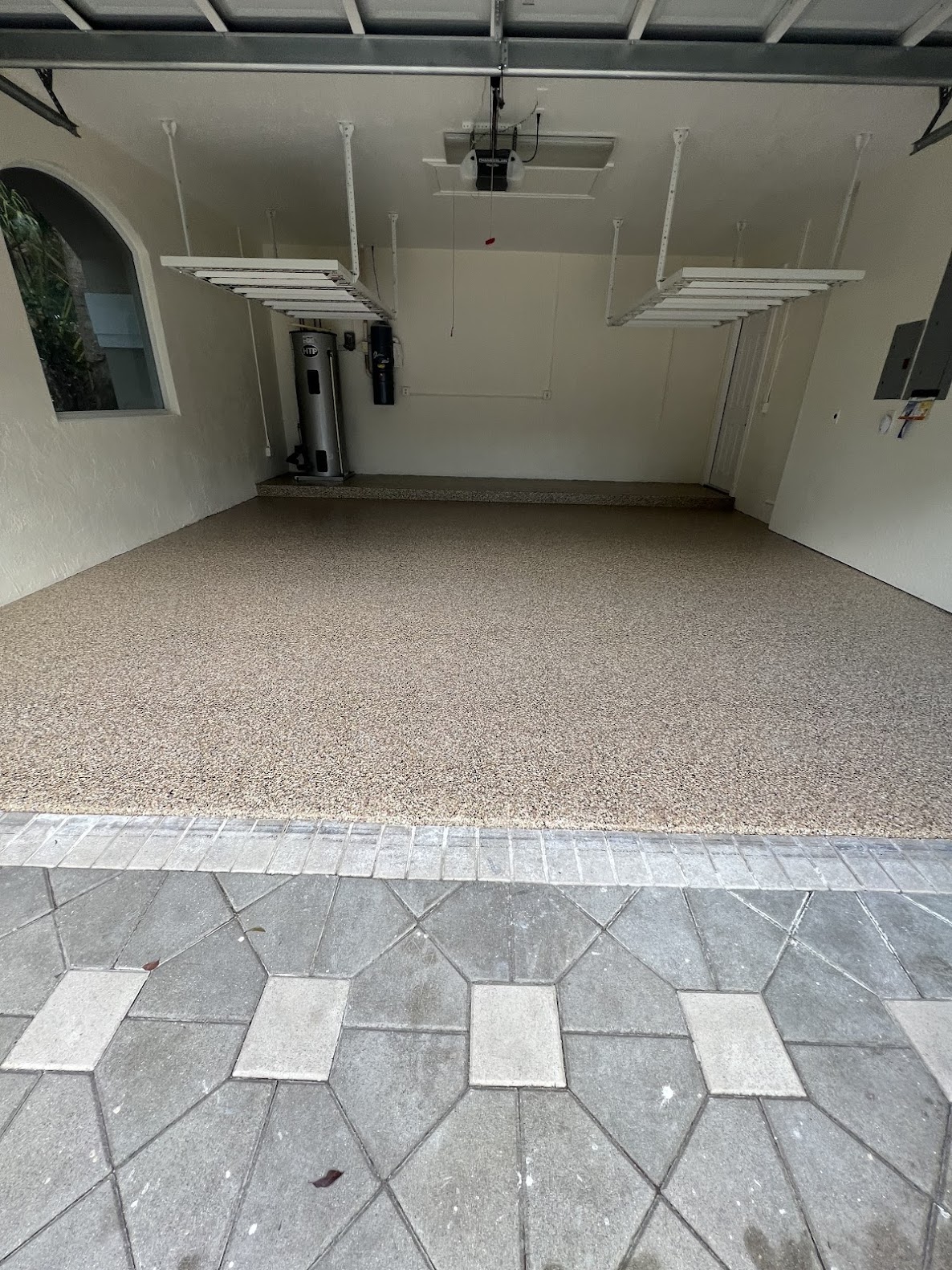
Get your new floor installed in just one day with FloorTek’s garage floor resurfacing services! Call us today for a free quote!
Or contact us online to schedule your consultation!
Testimonials
See What Our Customers Have To Say
★★★★★We had both of our garages done and an outdoor concrete platform. The crew was courteous and professional. Everyone from Nancy our salesperson to Patrick, the manager, Logan and his crew were outstanding. Our floors look fantastic and we were very happy we chose this company.
★★★★★I am very pleased with the quality of work FloorTek has done for me. The two employees that did the actual work were very courteous, worked hard, and explained everything they were doing. Thank you for a great job.
Contact FloorTek Today
Join Thousands of Satisfied Homeowners Nationwide!
Birmingham, AL
Address
250 Mullins DrHelena, AL 35080
Huntsville, AL
Address
108 Tribble DriveMadison, AL 35758
Stuart, FL
Address
3050 SE Federal HwyStuart, FL 34994
Detroit, MI
Address
140 Engelwood Dr, Suite ILake Orion, MI 48359
Houston, TX
Address
4109 Katy Hockley Rd. Unit 1Katy, TX 77493
Columbus, OH
Address
6670 Busch BlvdColumbus, OH 43229
Call Now (844) 844-4164